



Is Hiring A Professional Organizer Worth It For Your Kitchen In 2026?
For most homeowners, hiring a professional organizer for the kitchen is worth it. A typical kitchen session runs $250–$600, takes 3–6 hours, and creates systems that last 1–3 years with minimal upkeep. Compare that to a DIY project that eats 10–20 hours of your weekend and usually falls apart within a few months. I’ve seen it over and over: people buy bins, shove things into containers, call it organized, and six weeks later the junk drawer is overflowing again.
A professional kitchen organizer is a trained specialist who declutters, redesigns, and creates custom storage systems inside your existing cabinets, pantry, and countertops. The national average for a kitchen-specific session is $250–$400 for roughly three hours of hands-on work, according to  Fixr’s 2026 cost data.
This article covers real pricing, what you actually get for the money, how to tell if DIY is enough, and how to choose someone who won’t waste your budget on pretty bins you’ll never use. We won’t cover full kitchen remodels or cabinet refacing. That’s a different conversation with a different price tag.
How Much Does a Kitchen Organizer Cost in 2026?
The short answer: expect to spend between $250 and $600 for a standard kitchen project. The exact number depends on your kitchen’s size, how much clutter you’re dealing with, and whether your organizer charges hourly or flat-rate.
Hourly rates nationally sit between $50 and $150, with Thumbtack reporting an average of $60–$75 as of September 2025. Fixed-price kitchen sessions average around $365 on Thumbtack and $530 for a full home-organization project on Angi (October 2025). Those two numbers aren’t contradictory. Angi’s figure includes larger-scope jobs beyond just the kitchen.
Regional pricing swings more than most people expect. A project averaging $304 in Columbus, Ohio jumps to $492 in Phoenix, according to Angi’s 2026 city-level data. Coastal and high-cost-of-living areas typically run 15–30% above Midwest averages. Most national articles skip this detail entirely, which is why people in Atlanta or Baltimore get sticker shock when they request quotes.
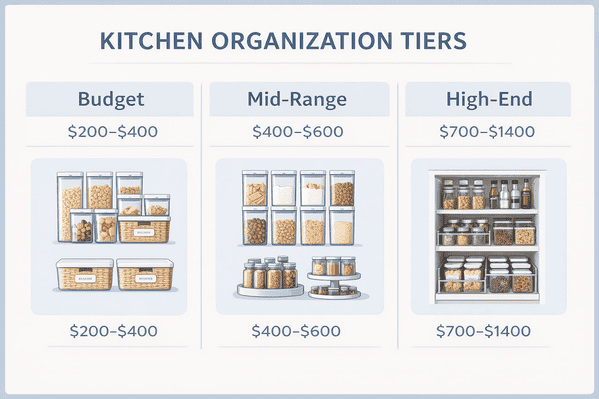
What Does Each Tier of Kitchen Organization Look Like?
Tier | Hourly Rate | Project Cost | What You Get |
Budget | $50–$60/hr | $200–$400 | Basic declutter, off-the-shelf bins, pantry reset |
Mid-Range | $65–$100/hr | $400–$600 | Custom labels, drawer inserts, full cabinet overhaul (4–6 hrs) |
High-End | $125–$150+/hr | $700–$1,400 | Full pantry redesign, product sourcing, ongoing coaching |
One thing I tell every client: the organizer’s hourly rate is only part of the bill. Bins, baskets, dividers, and labels usually cost an extra $50–$200. Some pros pass along trade discounts on products. Others don’t. Ask upfront.
What Are the Real Benefits of Hiring a Kitchen Organizer?
The benefits go beyond a clean countertop. But let’s be specific, because vague promises like "less stress" don’t help you decide if this is worth $400.
Does a Professional Organizer Actually Save You Time?
Yes, and it’s not close. A professional finishes a kitchen in 3–6 hours. The same job done by a homeowner typically takes 10–20 hours spread across multiple weekends. Pros move fast because they’ve done it hundreds of times. They see patterns in clutter that you don’t. And they aren’t emotionally attached to the chipped mug your aunt gave you in 2014.
I’ve worked with organizing teams that could fully reorganize a 200-square-foot kitchen, including pantry, in a single afternoon. A homeowner doing the same job often stalls in the "decision phase," holding up each item and debating whether to keep it. Organizers bypass that paralysis. They sort, categorize, and create systems while you make the keep-or-toss calls.
Custom Systems Built Around How You Actually Cook
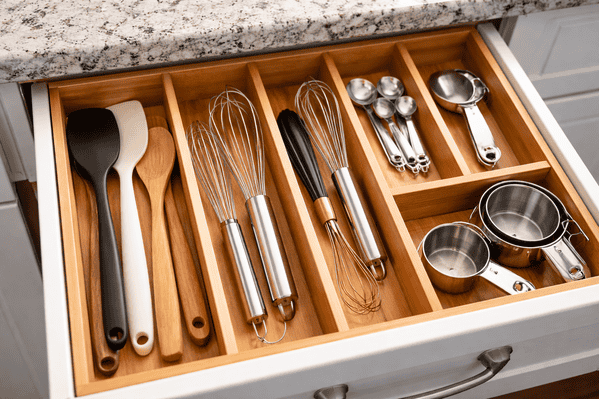
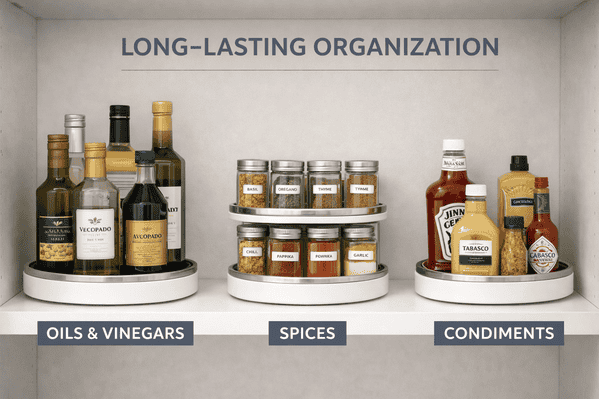
This is where professional organizers earn their money. Off-the-shelf solutions from big-box stores look great on Instagram. But a clear acrylic bin doesn’t fix the fact that your spices are on the wrong side of the kitchen from your stove, or that you’re storing baking sheets in a cabinet you can’t reach without a step stool.
A good organizer watches how you move through the kitchen. They ask what you cook most often, how many people use the space, and where your workflow breaks down. Then they build a layout around your habits. That’s the difference between a system that lasts and a system that looks nice for a week. The NKBA’s 2025 Kitchen Trends Report, which surveyed more than 15,000 projects, found that clutter reduction now ranks among the top 20 design priorities for kitchen renovations.
Is the Cost of a Professional Organizer Actually Worth It?
Here’s the contrarian take nobody in this industry wants to hear: for some kitchens, hiring a professional organizer is a waste of money.
If your kitchen is small, you cook once or twice a week, and your clutter problem is really just a "I need to throw out expired cans" problem, save your cash. Buy a label maker and spend a Saturday afternoon on it. You’ll be fine.
But if you’re dealing with a kitchen that serves a family of four, doubles as a homework station, and hasn’t been properly organized since you moved in, then the $250–$600 is one of the better investments you’ll make in your home this year. The ROI isn’t just financial (though Mordor Intelligence reports that closet and organizer retrofits recoup roughly 83% of cost at resale). The ROI is in the 15 minutes a day you stop wasting looking for things.
Think about it with real numbers. If you waste 10 minutes a day searching through disorganized cabinets, that’s about 60 hours a year. A $400 organizing session that cuts that in half is paying you back at roughly $3.30 per hour saved. Not glamorous math, but it adds up.
DIY Kitchen Organization vs. Hiring a Pro: Which Makes Sense?
Factor | DIY | Professional |
Cost | $100–$300 (materials only) | $250–$600 (labor + products) |
Time Investment | 10–20 hours | 3–6 hours |
How Long It Lasts | Often reverts in 2–4 months | 1–3+ years with a maintenance plan |
Skill Required | Trial and error | Trained systems and product knowledge |
Emotional Support | You’re on your own | Neutral third party for tough decisions |
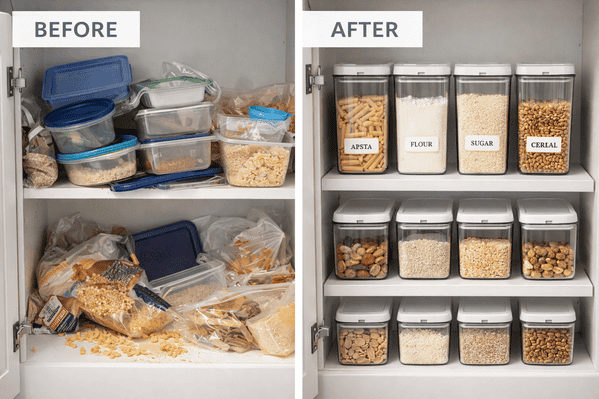
The biggest mistake I see with DIY kitchen organization? People buy storage products first, then try to fit their stuff into them. Professionals do the opposite. They declutter 30–50% of what’s in your cabinets before recommending a single container. Otherwise, you’re just organizing clutter inside prettier boxes.
What Happens During a Kitchen Organization Session?
Most sessions follow a similar pattern, though the specifics vary by organizer.
First, there’s a consultation. Some organizers offer this free. Others charge a flat fee (typically $50–$100). During the consult, they’ll assess your kitchen, talk about your pain points, and give you a rough time and cost estimate. Keep in mind that if your kitchen needs serious decluttering, the organizer can only work as fast as you can make decisions about what stays and what goes.
Then comes the actual session. Everything comes out of the cabinets. All of it. It gets worse before it gets better. The organizer sorts items into categories, identifies duplicates and expired products, and starts building zones: cooking zone near the stove, prep zone near the counter, storage zone for rarely used items up high. Once the system is in place, they’ll label everything and walk you through how to maintain it.
A solid organizer will also leave you with a written maintenance plan or at least a follow-up check-in schedule. If they don’t offer this, ask for it. Systems without maintenance tend to break down within 3–6 months.
How Do You Choose the Right Professional Organizer?
Not all organizers are created equal. Certified pros (look for NAPO membership or the BCPO credential from the Board of Certification for Professional Organizers) tend to charge 50–100% more than uncertified ones. But they also deliver more structured systems and often include maintenance coaching.
Questions most people never think to ask their organizer:
1. Do you provide a written maintenance plan or follow-up session?
2. Are you a NAPO member or BCPO-certified?
3. What percentage of my stuff will you recommend donating or tossing?
4. Do you pass along trade discounts on products?
5. Can I see before-and-after photos from a similar kitchen project?
If you’re in the Cincinnati area, working with an experienced organizing team who knows local homes and lifestyles makes a real difference compared to hiring someone sight-unseen from an app.

How Long Does Professional Kitchen Organization Last?
With a maintenance plan, most professional kitchen setups hold for 1–3 years before needing a refresh. Without one, expect things to drift back toward chaos in 3–6 months. That’s not a knock on the organizer. It’s just how homes work. New gadgets come in. Holidays bring gifts. Kids grow up and their stuff changes.
The best organizers set you up to maintain the system yourself. They create intuitive layouts, add labels, and teach you the "one in, one out" rule so cabinets don’t slowly refill with stuff you don’t use. Some offer a follow-up visit 60–90 days after the initial session for a tune-up, and honestly, that’s worth the extra $100–$150 if it’s available.
The One Takeaway That Matters
Hiring a professional organizer for your kitchen isn’t about making things look nice. It’s about buying back time every single day. If your kitchen is a daily source of friction, a $250–$600 investment that saves you 30+ hours a year and actually sticks is hard to argue against. Just make sure you’re hiring someone who’ll build systems around your life, not someone who shows up with a trunk full of matching containers and calls it a day.
FAQs
How much does hiring a professional organizer for a kitchen cost?
A kitchen-specific organizing session typically costs $250–$400 for about three hours of work. Full kitchen projects with product sourcing and pantry redesign can run $600–$1,400. Hourly rates range from $50 to $150 nationally, with the average sitting around $60–$75 per hour according to Thumbtack’s September 2025 data.
Is hiring a professional organizer worth the money for a small kitchen?
It depends on the complexity. If your small kitchen just needs expired items purged and a few bins, a DIY approach costing $100–$300 in materials is probably enough. But if the layout causes daily friction (wrong items in wrong cabinets, no workflow logic), a 3-hour professional session at $250–$400 can solve problems you’d spend 15+ hours trying to fix yourself.
How long does a professional kitchen organization last?
With a maintenance plan, most professional kitchen setups hold for 1–3 years. Without one, systems typically degrade within 3–6 months. A follow-up session 60–90 days after the initial project costs $100–$150 and significantly extends the life of the system.
Should I declutter my kitchen before the organizer arrives?
You don’t have to, but organizers recommend purging 30–50% of kitchen items before the session. Toss expired pantry goods, duplicates, and anything you haven’t used in a year. If you skip this step, you’ll pay billable hours ($50–$150/hr) for the organizer to help you make those decisions.
What’s the difference between a kitchen designer and a professional organizer?
A kitchen designer remodels cabinets, countertops, and layouts, usually costing $5,000–$30,000+. A professional organizer works within your existing kitchen layout, optimizing storage and workflow in 3–6 hours for $250–$600. Organizers don’t move plumbing or install new cabinetry.
Do professional organizers recommend specific products?
Yes. Most organizers suggest bins, drawer dividers, turntable organizers, and labeling systems based on your specific kitchen. Product costs typically run $50–$200 on top of the service fee. Some organizers get trade discounts and pass the savings along. Always ask about this before hiring.
How do I know if a kitchen organizer is qualified?
Look for membership in the National Association of Productivity and Organizing Professionals (NAPO) or a BCPO credential from the Board of Certification for Professional Organizers. Certified pros charge more (often 50–100% above uncertified organizers) but deliver more structured, longer-lasting systems.